



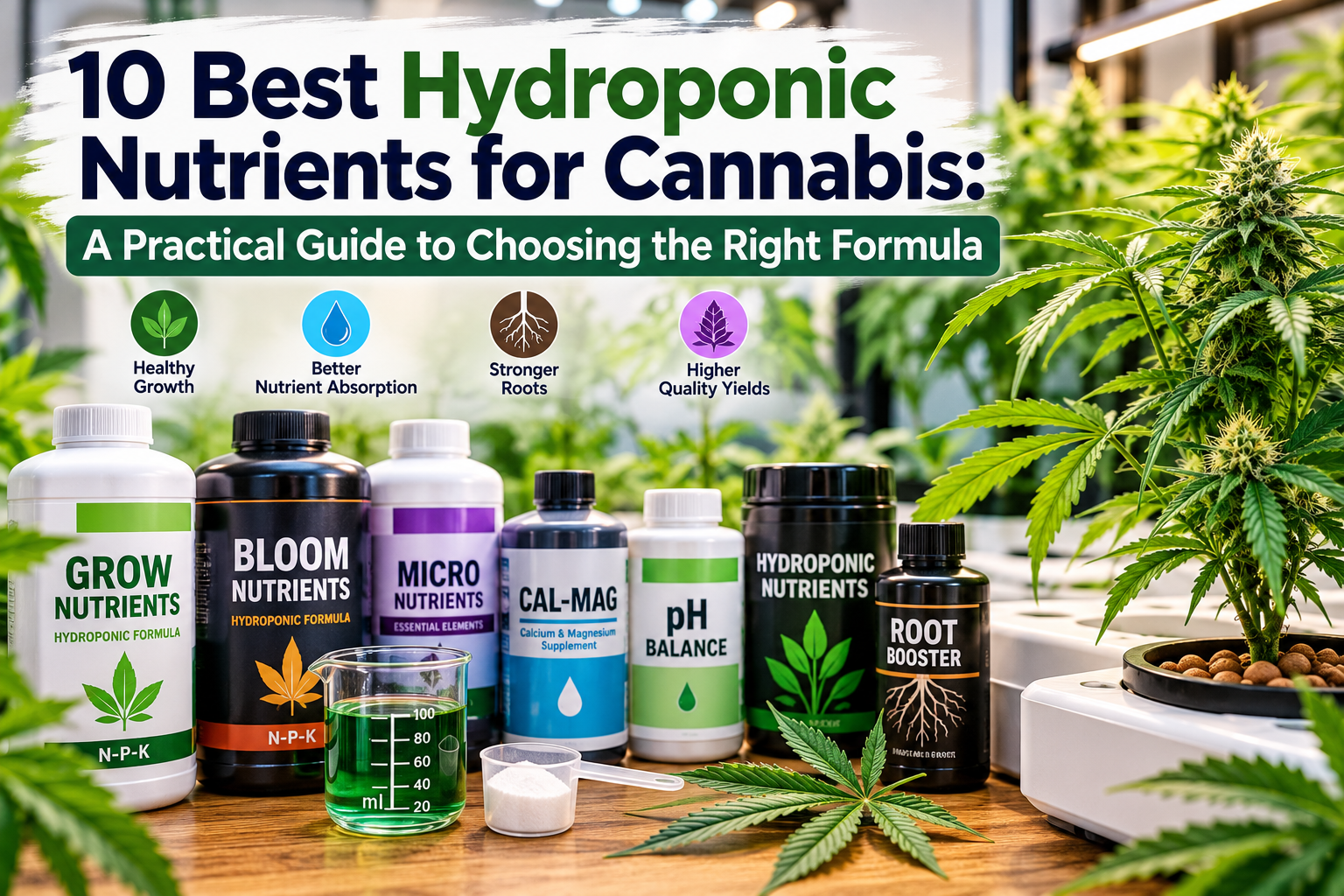
Choosing the right nutrients is an important part of understanding hydroponic plant nutrition. The 10 Best Hydroponic Nutrients for Cannabis: guide below explains the main nutrient formulas, their benefits, and the factors that influence nutrient quality. Rather than relying on brand rankings alone, it focuses on nutrient types and formulation features that help readers compare available products.
Hydroponic systems deliver nutrients through water instead of relying on soil. This makes nutrient balance, water quality, pH, and concentration especially important. A suitable formula supplies essential elements while remaining compatible with the growing system and the water being used.
1. What Makes a Hydroponic Nutrient Formula Effective?
A hydroponic nutrient formula should provide the essential elements plants need for normal growth. These include nitrogen, phosphorus, potassium, calcium, magnesium, sulfur, and smaller quantities of micronutrients such as iron, manganese, zinc, copper, boron, and molybdenum.
A product’s suitability depends on more than its label. Consider its nutrient analysis, solubility, compatibility with the system, and the quality of the water used to prepare the solution.
For an introduction to nutrient balance and water quality in soilless growing systems, the University of Missouri Extension guide to hydroponic nutrient solutions explains important principles of nutrient management and nutrient availability.
Key features to compare
- Complete nutrient profile: Check whether the formula provides essential macro- and micronutrients.
- Solubility: The product should dissolve appropriately for its intended hydroponic system.
- Product compatibility: Some formulas are designed for specific systems or feeding programs.
- Clear labeling: Reliable products provide a nutrient analysis and mixing instructions.
- Quality assurance: Look for appropriate manufacturing standards and information about contaminants.
2. The 10 Best Hydroponic Nutrients for Cannabis: Types Worth Comparing
There is no single formula that is best for every hydroponic setup. The following ten categories provide a practical way to compare nutrient products without treating unverified brand claims as proven rankings.
1. Complete Hydroponic Nutrient Formulas
Complete formulas are designed to supply a broad range of essential plant nutrients. They can be a convenient starting point for comparing products because the nutrient profile is presented as one coordinated solution or system.
Check the product label carefully. Some complete formulas still require a separate supplement, depending on water quality and the manufacturer’s instructions.
2. Two-Part Nutrient Systems
Two-part systems separate nutrients into two concentrated products. This approach can help manufacturers maintain compatibility among ingredients that may react if stored together at high concentrations.
Follow the label’s mixing order and dilution instructions. Never assume that products from different nutrient systems can be combined safely or in the same proportions.
3. Three-Part Nutrient Systems
Three-part systems divide the nutrient formulation among three components. They offer flexibility, but they also require careful measuring and consistent preparation.
Compare the complete nutrient profile rather than judging the product by the number of bottles. A multi-part system is not automatically more effective than a well-formulated single-product alternative.
4. Mineral-Based Nutrient Formulas
Mineral-based formulas provide nutrients in forms intended for plant uptake through the nutrient solution. They are commonly used in hydroponic systems because their composition can be specified and monitored.
Product quality, solubility, water chemistry, and proper use all influence performance. Read the analysis and instructions before selecting a mineral-based formula.
5. Water-Soluble Nutrient Powders
Powdered nutrients can be practical to store and transport. They may also offer a convenient option for preparing larger quantities of nutrient solution.
However, the powder must be suitable for hydroponic use and dissolve as directed. Undissolved material or incompatible products can contribute to deposits and system problems.
6. Liquid Hydroponic Nutrients
Liquid products are often easy to measure and mix. They can suit users who prefer a ready-to-dilute format instead of weighing powders.
Consider storage requirements, concentration, price per prepared volume, and the product’s stated compatibility. A higher-priced liquid is not necessarily better than a suitable powder.
7. Calcium and Magnesium Supplements
Calcium and magnesium are essential nutrients, but whether a separate supplement is needed depends on the primary formula and source water.
Adding a supplement without checking the existing nutrient levels can create an imbalance. Review the water analysis and complete nutrient label before deciding whether an additional product is appropriate.
8. Micronutrient Blends
Micronutrient blends supply elements needed in relatively small amounts, including iron, manganese, zinc, copper, boron, and molybdenum.
Because these elements are required in small quantities, more is not always better. Compare the stated concentrations and ensure that the blend is intended for the relevant hydroponic application.
9. Chelated Micronutrient Formulas
Chelation can help keep certain micronutrients available in solution under particular chemical conditions. This may be relevant when water chemistry or pH affects nutrient availability.
The word “chelated” alone does not guarantee a superior product. Check which nutrients are chelated, the formulation details, and whether the product is suitable for the intended system.
10. Nutrients With Strong Quality Documentation
A final category to consider is products supported by clear labeling, reliable manufacturing information, and appropriate quality documentation.
Where available, review information about contaminant testing, product registration, and compliance with local requirements. Documentation provides a more useful basis for comparison than unsupported claims about exceptional results.
3. How to Compare Hydroponic Nutrient Products
When comparing options, begin with the nutrient analysis and intended application. Two products with similar names may have different concentrations, ingredients, or mixing requirements.
Use these factors to assess the available options:
- Nutrient completeness: Does the formula include the essential elements required for its stated purpose?
- Concentration: Compare the amount of product needed to prepare the specified volume of solution.
- Water compatibility: Consider the mineral content and alkalinity of the source water.
- Ease of use: Decide whether a single-part, two-part, three-part, powder, or liquid format best fits your needs.
- Documentation: Look for transparent labeling, clear directions, and credible quality information.
- Overall cost: Compare cost per prepared volume rather than package price alone.
The most suitable choice is the product that meets the system’s requirements, provides clear instructions, and can be used consistently and appropriately.
4. Understanding pH, Water Quality, and Nutrient Availability

Nutrient quality is only one factor in hydroponic plant nutrition. Water chemistry also affects whether nutrients remain available in the solution.
Source water may contain minerals or alkalinity that influence the final solution. For this reason, it is useful to understand the properties of the water being used rather than assuming that every source is the same.
pH can influence nutrient availability, while excessive concentrations of dissolved salts may affect plant health. Measurements should be interpreted according to the specific hydroponic system, product directions, and relevant professional guidance.
Avoid making repeated adjustments without checking measurements and understanding the cause of a problem. Changes to nutrient concentration or pH should be based on reliable information rather than guesswork.
5. Common Mistakes When Choosing Hydroponic Nutrients
Even a well-formulated product may not perform as expected if it is unsuitable for the system or used incorrectly. These are common mistakes to avoid.
Choosing a product based only on popularity
Online reviews can help identify user experiences, but they do not establish that a formula is appropriate for every situation. Check the product analysis, documentation, and intended application.
Assuming more nutrients produce better results
Excessive nutrient concentrations can cause imbalances and may damage plants. Follow the label and avoid combining supplements without understanding their contribution to the overall solution.
Ignoring source water
Water quality can influence nutrient availability and the final solution’s composition. Where possible, review relevant water-quality information before comparing nutrient products.
Mixing incompatible products
Concentrated nutrient components may react when combined directly. Follow the manufacturer’s mixing sequence and dilution instructions, and do not combine products unless their compatibility is established.
Overlooking product quality
Incomplete labels, unclear directions, and unsupported performance claims make products harder to evaluate. Prefer transparent information and reputable suppliers.
6. Where to Find Reliable Information
Reliable information helps readers evaluate hydroponic products without relying solely on advertising. University extension resources, product labels, relevant government guidance, and credible technical documentation can provide useful background.
For example, the University of Missouri Extension’s hydroponic nutrient guide offers information about nutrient solutions and their management. Regulatory guidance can also help clarify product requirements in different jurisdictions. The Canadian Food Inspection Agency’s information on fertilizers and supplements for cannabis cultivation is one resource for understanding Canadian requirements.
Readers interested in exploring additional gardening, lifestyle, and general-interest topics can also visit Urban Splatter. It offers articles across different subjects for readers who want to explore topics beyond hydroponic nutrient selection.
Always check the rules that apply where you live. Product availability, labeling, and permitted uses can vary by jurisdiction.
7. Pros and Cons of Hydroponic Nutrient Systems
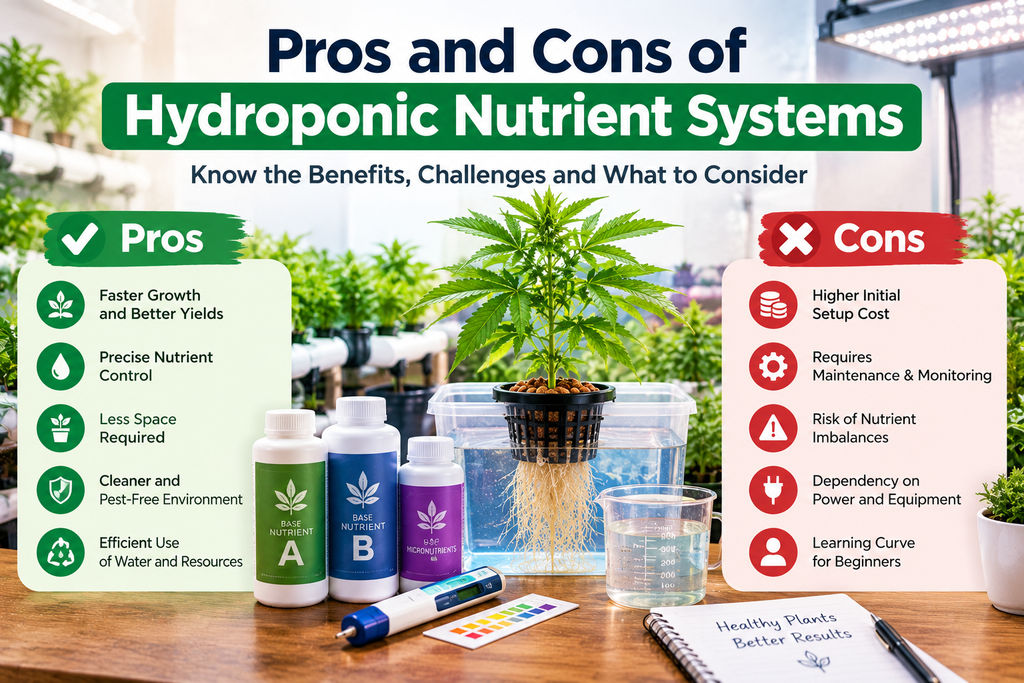
Understanding the advantages and limitations of hydroponic nutrients can make product comparisons easier.
Pros
- Nutrient formulations can be selected according to the requirements of a particular hydroponic system.
- Products with clear labels make it easier to compare nutrient composition.
- Water-soluble formulas are designed for use in nutrient solutions.
- Different product formats provide options for storage, measuring, and preparation.
Cons
- Some multi-part formulas require more measuring and preparation.
- Water chemistry can affect the suitability of a product.
- Additional supplements may increase cost and complicate nutrient management.
- Poorly chosen or incorrectly prepared solutions can create imbalances.
The best approach is to prioritize a suitable formulation, transparent documentation, and correct use rather than assuming that a more complex or expensive product will always be better.
Frequently Asked Questions
1. What are the best hydroponic nutrients for cannabis?
There is no universal best product for every hydroponic system. Compare complete nutrient profiles, product compatibility, solubility, water quality requirements, and the manufacturer’s documentation before making a choice.
2. Are liquid nutrients better than powdered nutrients?
Not necessarily. Liquid products can be convenient to measure, while powders may be easier to store and transport. The better option depends on product quality, intended use, preparation requirements, and overall cost.
3. Do hydroponic nutrients need a separate calcium and magnesium supplement?
Not always. Some formulas and source waters already provide these elements in sufficient amounts for their intended use. Check the nutrient analysis and water quality before adding a separate supplement.
4. Why is pH important in hydroponic nutrient solutions?
pH affects the availability of certain nutrients in water-based growing systems. Its importance depends on the system and the nutrient formulation, so measurements should be interpreted using suitable technical guidance.
5. How can I identify a reliable hydroponic nutrient product?
Look for a clear nutrient analysis, appropriate instructions, credible manufacturing information, and relevant quality documentation. Be cautious of products that rely on dramatic claims without supporting evidence.
Conclusion
The 10 Best Hydroponic Nutrients for Cannabis: guide provides a framework for comparing complete formulas, multi-part systems, powders, liquids, supplements, micronutrient blends, and products with strong quality documentation.
Rather than choosing a product based on popularity alone, assess its nutrient profile, compatibility, solubility, labeling, and cost per prepared volume. Water quality and correct preparation also matter when evaluating hydroponic nutrient solutions.
For a more informed decision, use credible technical resources, read product labels carefully, and follow applicable local regulations. A transparent, suitable formula is a more dependable starting point than unsupported claims about any single product being the best for every situation.