



The top 8 best managed it services providers can help businesses manage technology more efficiently, strengthen cybersecurity, maintain reliable systems, and support long-term digital growth. Choosing the right provider depends on your business size, budget, technical requirements, and the level of support your team needs.
Managed IT services allow organizations to outsource selected technology responsibilities to external specialists. These services may include IT support, cloud management, network monitoring, application maintenance, cybersecurity, and disaster recovery. Instead of handling every technical challenge internally, businesses can work with an experienced provider to maintain essential systems and reduce operational pressure.
This guide compares 10 established enterprise IT service providers, explains their potential strengths and limitations, and shares practical advice for selecting a suitable technology partner. The companies are presented as options to evaluate, not as a definitive ranking of service quality.
What Are Managed IT Services?
Managed IT services involve outsourcing ongoing IT responsibilities to a third-party company under an agreed service arrangement. Depending on the contract, a provider may monitor infrastructure, manage cloud environments, maintain business applications, support employees, and help protect sensitive information.
Some providers specialize in small and medium-sized businesses, while others focus on large enterprises with complex infrastructure and international operations.
Common managed IT services include:
- IT support and help desk: Troubleshooting employee devices, software, and access issues.
- Managed cybersecurity: Supporting threat monitoring, security controls, and incident response.
- Cloud management: Maintaining cloud infrastructure, workloads, and availability.
- Network management: Monitoring connectivity, servers, and network equipment.
- Backup and disaster recovery: Helping organizations restore data and systems after disruptions.
- Application management: Maintaining business software and supporting updates.
- IT consulting: Planning technology improvements and modernization.
Top 8 Best Managed IT Services Providers to Consider
The following companies have established enterprise technology and managed services portfolios. Their suitability depends on the services required, geographic coverage, industry experience, and contract terms.
1. Accenture
Accenture is a global professional services company offering managed services alongside consulting, cloud, data, AI, and technology transformation.
Its capabilities cover infrastructure operations, application management, and technology-related business operations. Organizations that want to modernize complex systems while maintaining ongoing support may consider Accenture.
Best for: Large enterprises pursuing digital transformation and integrated technology operations.
Advantages: Broad service portfolio, global delivery capabilities, and experience supporting complex transformation initiatives.
Potential disadvantages: Its extensive capabilities may exceed the needs of smaller businesses, and large engagements can require significant planning and investment.
Website: Accenture Managed Services
2. IBM Consulting
IBM provides enterprise technology services involving hybrid cloud, infrastructure, applications, automation, and IT modernization. Its experience with complex enterprise environments can be useful for organizations managing both traditional systems and newer cloud platforms.
Businesses that rely on mission-critical applications may consider IBM when they need specialized technical support.
Best for: Enterprises with complex infrastructure, hybrid cloud requirements, or legacy systems.
Advantages: Enterprise technology expertise and a broad range of infrastructure and consulting capabilities.
Potential disadvantages: Businesses should carefully assess implementation requirements, service scope, and total contract costs before committing.
Website: IBM Consulting
3. Tata Consultancy Services (TCS)
Tata Consultancy Services is a global IT services and consulting company supporting enterprise infrastructure, applications, cloud operations, and technology transformation.
Its broad portfolio may suit organizations looking for a long-term partner to support technology operations across multiple departments or locations.
Best for: Large organizations requiring scalable IT operations and application management.
Advantages: Broad enterprise capabilities and experience supporting complex, multinational environments.
Potential disadvantages: Large projects may require detailed transition plans, structured governance, and coordination between internal teams and external specialists.
Website: Tata Consultancy Services
4. Infosys
Infosys offers infrastructure and cloud services designed to help organizations manage and modernize their IT environments. Its capabilities include infrastructure management, cloud operations, network services, and digital workplace support.
Businesses seeking to improve operational consistency while updating older systems may find Infosys worth evaluating.
Best for: Enterprises pursuing infrastructure modernization and managed cloud operations.
Advantages: Infrastructure expertise, cloud management capabilities, and technology lifecycle planning.
Potential disadvantages: Results depend on clearly defined responsibilities, realistic service targets, and an effective transition process.
Website: Infosys Infrastructure Services
5. NTT DATA
NTT DATA provides technology services that include managed networks, infrastructure, cloud solutions, and enterprise IT support. Its network capabilities may be relevant to organizations with distributed offices, connected facilities, and employees working across multiple locations.
Best for: Businesses with complex network requirements or multinational operations.
Advantages: Network management expertise and a broad enterprise technology portfolio.
Potential disadvantages: Companies should confirm local coverage, support availability, and compatibility with existing infrastructure before selecting a service.
Website: NTT DATA
6. HCLTech
HCLTech offers technology and managed services across enterprise applications, infrastructure, service management, and digital workplace operations.
Its capabilities may help organizations improve IT workflows, standardize support processes, and introduce automation where appropriate.
Best for: Enterprises seeking managed infrastructure, workplace support, and service management improvements.
Advantages: Enterprise service management expertise, automation capabilities, and support for complex environments.
Potential disadvantages: The proposed services should align with the company’s existing processes, and the transition plan should account for system dependencies.
Website: HCLTech
7. Cognizant
Cognizant provides infrastructure, cloud, application, and digital workplace services. Its portfolio supports organizations that want to maintain existing technology while modernizing selected parts of their IT environment.
Best for: Enterprises looking for infrastructure management, hybrid cloud support, and application services.
Advantages: Broad infrastructure capabilities and experience with enterprise application environments.
Potential disadvantages: Businesses should define performance measures clearly and ensure that modernization projects do not disrupt daily operations.
Website: Cognizant
8. Wipro
Wipro provides managed services for enterprise applications, networks, and technology infrastructure. Depending on the agreement, its services can include application support, infrastructure operations, and network management.
Organizations seeking consistent IT operations may evaluate Wipro against their existing systems and long-term business objectives.
Best for: Businesses needing managed application services, network operations, and enterprise IT support.
Advantages: Multiple managed service options and experience supporting large technology environments.
Potential disadvantages: Businesses should review escalation procedures, service responsibilities, and communication arrangements before signing a contract.
Website: Wipro
9. DXC Technology

DXC Technology provides enterprise IT services that include managed infrastructure, cloud and infrastructure operations, and application management.
It may be suitable for organizations that need to maintain important existing systems while gradually modernizing their technology environments.
Best for: Enterprises with complex infrastructure and business-critical applications.
Advantages: Managed infrastructure capabilities and application modernization services.
Potential disadvantages: Companies should evaluate how the provider handles legacy dependencies, transition risks, and integration with other technology vendors.
Website: DXC Technology
10. Kyndryl
Kyndryl specializes in enterprise technology services, including managed cloud, infrastructure, networks, workplace, and application services.
Its experience with complex IT environments may be useful for organizations that need to maintain important systems while planning infrastructure improvements.
Best for: Large organizations with complex infrastructure, hybrid cloud environments, and mission-critical workloads.
Advantages: Enterprise infrastructure specialization and support for hybrid IT environments.
Potential disadvantages: Smaller organizations with straightforward requirements may find a regional or small-business-focused provider more suitable.
Website: Kyndryl
Advantages and Disadvantages of Managed IT Services
Outsourcing IT operations can provide useful benefits, but it also introduces responsibilities that businesses need to manage.
Advantages of Managed IT Services
Access to specialist expertise: Businesses can work with professionals experienced in cloud systems, cybersecurity, networks, and enterprise applications.
More predictable operations: A clearly defined service agreement can establish support hours, monitoring responsibilities, and response targets.
Scalability: Organizations can adjust their service coverage as their teams, locations, or technology requirements change.
Greater internal focus: Employees can spend less time resolving routine technical problems and more time on core business activities.
Proactive maintenance: Appropriate monitoring and maintenance can help identify certain problems before they cause major disruptions.
Disadvantages of Managed IT Services
Ongoing costs: Recurring fees and optional services can become expensive if the contract is not carefully evaluated.
Reduced direct control: Some operational decisions move to the provider, making communication and governance especially important.
Vendor dependency: Moving systems or transferring responsibilities can become difficult if exit arrangements are unclear.
Security and privacy risks: Giving an external provider access to systems and data requires appropriate controls, oversight, and contractual safeguards.
Service limitations: A provider may not cover every system, location, or support scenario unless those responsibilities are explicitly included.
How to Choose the Right Managed IT Services Provider
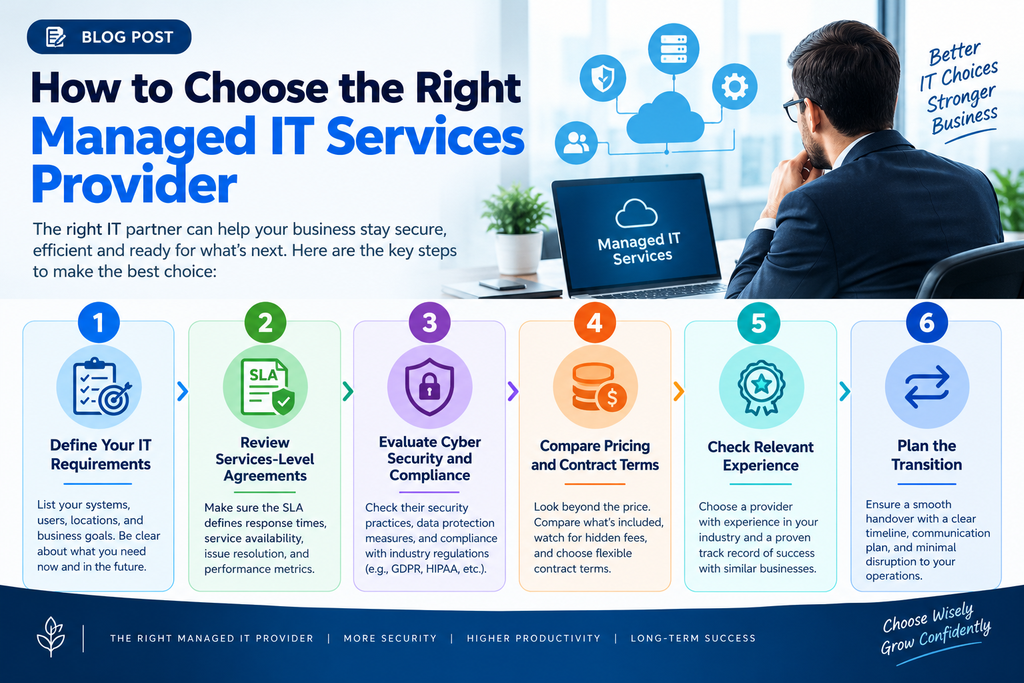
When comparing the top 8 best managed it services providers or evaluating all 10 companies in this guide, begin with your organization’s requirements rather than brand recognition.
1. Define Your IT Requirements
List the systems that need support, such as employee devices, cloud infrastructure, business applications, networks, backups, and security monitoring. Identify your current problems and the outcomes you expect from the provider.
2. Review Service-Level Agreements
A service-level agreement (SLA) should define responsibilities, response targets, availability commitments, reporting, and escalation procedures. Make sure the contract distinguishes between response time and resolution time.
3. Evaluate Cybersecurity and Compliance
Ask how the provider handles privileged access, encryption, vulnerability management, incident reporting, backups, and data protection.
The NIST Cybersecurity Framework is a useful authoritative resource for understanding how organizations can assess and manage cybersecurity risks. Businesses can use it to prepare questions about security monitoring, access controls, incident response, and data protection before signing a managed IT services agreement.
4. Compare Pricing and Contract Terms
Request a clear breakdown of recurring fees, onboarding costs, optional services, and out-of-scope work. Review renewal terms, price adjustments, minimum commitments, and exit assistance.
5. Check Relevant Experience
Look for experience supporting organizations with similar size, infrastructure, and industry requirements. Ask for relevant case studies or references, and verify claims instead of relying entirely on marketing material.
6. Plan the Transition
A successful transition should document existing systems, access permissions, dependencies, support responsibilities, and backup arrangements. Agree on milestones and communication procedures before transferring operational responsibilities.
Managed IT can also support industries that rely on specialized digital tools. For example, businesses exploring digital solutions for project coordination and infrastructure may find this guide to construction technology useful for understanding how technology is changing construction processes. Aligning digital goals with the right IT support can help organizations make more informed infrastructure decisions.
Frequently Asked Questions
What is a managed IT services provider?
A managed IT services provider is an external company responsible for specific ongoing IT functions, such as technical support, infrastructure monitoring, cloud management, or cybersecurity, under an agreed service arrangement.
Which managed IT services provider is best?
There is no universal best provider. Accenture, IBM, TCS, Infosys, NTT DATA, HCLTech, Cognizant, Wipro, DXC Technology, and Kyndryl offer different service portfolios. The best fit depends on your budget, location, technical environment, and business requirements.
Are managed IT services suitable for small businesses?
Yes. Managed IT services can help small businesses access technical expertise without building a large internal IT department. However, several providers in this guide focus heavily on enterprise clients, so smaller businesses should also compare providers that specialize in small and medium-sized organizations.
How much do managed IT services cost?
Costs depend on the number of users and devices, service coverage, security requirements, infrastructure complexity, and support hours. Request a tailored quote and compare the full contract scope rather than relying on a general price estimate.
What should a managed IT services contract include?
A contract should clearly define the service scope, fees, SLAs, security responsibilities, data handling, reporting, escalation procedures, renewal conditions, and exit arrangements.
Conclusion
The top 8 best managed it services providers keyword offers a starting point for researching established technology partners, but choosing the right provider requires more than comparing company names. Accenture, IBM, TCS, Infosys, NTT DATA, HCLTech, Cognizant, Wipro, DXC Technology, and Kyndryl each offer capabilities that may suit different enterprise requirements.
Before making a decision, define your priorities, compare service-level agreements, evaluate security practices, and review the full contract cost. Confirm that the provider can support your existing systems and long-term plans, and establish a clear transition and exit process.
A well-chosen managed IT services partner should provide more than technical support. It should offer clear accountability, dependable operations, and services that align with your business goals.