



Michael Bloomberg and Lei Jun: Two Global Leaders Who Built Success in Very Different Ways is an insightful comparison of two entrepreneurs who transformed their industries through different strategies. Michael Bloomberg built a global financial information and media business before becoming mayor of New York City and a major philanthropist. Lei Jun, meanwhile, helped shape China’s technology industry through software, smartphones, connected devices, and Xiaomi’s expansion into international markets.
Although their backgrounds and business environments differ, both leaders recognized opportunities others overlooked. Bloomberg focused on making financial information more accessible and useful, while Lei Jun concentrated on developing technology products that combine practical features, competitive pricing, and a connected user experience.
Their journeys offer valuable lessons about innovation, leadership, business strategy, and the risks that accompany success. By examining their different approaches, entrepreneurs and aspiring business leaders can better understand how to build sustainable businesses in competitive markets.
Who Are Michael Bloomberg and Lei Jun?
Michael Bloomberg is an American entrepreneur, philanthropist, and former mayor of New York City. He founded Bloomberg L.P. in 1981 after working at the financial services firm Salomon Brothers. His company developed technology that helps financial professionals access market data, news, and analytical tools.
Lei Jun is a Chinese technology entrepreneur and the founder, chairman, and CEO of Xiaomi Corporation. He studied computer science at Wuhan University and developed his career in the software industry before expanding into consumer technology. He also held leadership positions at Kingsoft and founded Joyo.com, an online retail business acquired by Amazon in 2004.
Xiaomi, co-founded by Lei Jun in 2010, initially gained recognition for its smartphones and later expanded into connected home devices, wearables, and other consumer electronics. Readers can explore Xiaomi’s official leadership profile of Lei Jun for additional information about his career.
Although these entrepreneurs operate in different industries, their experiences demonstrate how understanding customers and identifying unmet needs can become the foundation of business success.
1. Michael Bloomberg: Turning Financial Information Into Opportunity
Bloomberg’s business journey illustrates the value of solving a specific professional problem. During his time on Wall Street, he gained firsthand experience with the difficulties financial professionals faced when accessing and analyzing market information.
After leaving Salomon Brothers in 1981, Bloomberg established Bloomberg L.P. His business focused on delivering financial data, market news, and analytical tools through technology designed for professional users.
Rather than attempting to serve every possible customer, Bloomberg concentrated on a market where accurate and timely information could directly influence important decisions.
The Power of a Specialized Business Model
Bloomberg’s strategy demonstrates several important principles:
- Solve a valuable problem: Financial professionals need reliable information to evaluate markets and make informed decisions.
- Build continuing value: Professional information services can generate recurring demand when customers rely on them for daily work.
- Understand the customer: Industry experience can reveal problems that outsiders might overlook.
- Invest in usefulness: A product becomes more valuable when it helps customers work efficiently and confidently.
Bloomberg’s success did not come simply from publishing news. It came from developing an integrated information service that became part of professional financial workflows.
His career also extended beyond business. He served three terms as mayor of New York City, from 2002 to 2013, and developed a substantial philanthropic presence through Bloomberg Philanthropies. His experience demonstrates how business leadership can extend into public service and charitable initiatives.
2. Lei Jun: Building a Technology Ecosystem With Xiaomi
Lei Jun followed a different path to success, developing his career around software, entrepreneurship, consumer technology, and product innovation.
After joining Kingsoft in 1992, Lei gained experience in software development and business leadership. He later founded Joyo.com and invested in other technology businesses. In 2010, he co-founded Xiaomi, which became known for smartphones and a broader ecosystem of connected products.
Xiaomi’s approach combined competitive pricing, product design, online engagement, and relationships with technology enthusiasts. Instead of depending on a single product category, the company expanded into connected devices and other consumer technologies.
Why Xiaomi’s Strategy Attracted Attention
Lei Jun’s business approach highlights several lessons.
Customer value matters. Products need to offer features and experiences that customers consider worth paying for.
Brand identity creates recognition. Consistent branding and product design help consumers understand what a company represents.
Related products create opportunities. A smartphone business can expand into wearables, smart-home products, and other connected devices.
Customer feedback supports improvement. Businesses can use feedback to refine products, identify demand, and improve their market positioning.
Lei’s leadership illustrates how technology companies can grow by combining product development with a broader ecosystem. However, maintaining that ecosystem requires reliable software, product support, supply chains, and customer trust.
3. Michael Bloomberg and Lei Jun: Two Different Leadership Styles
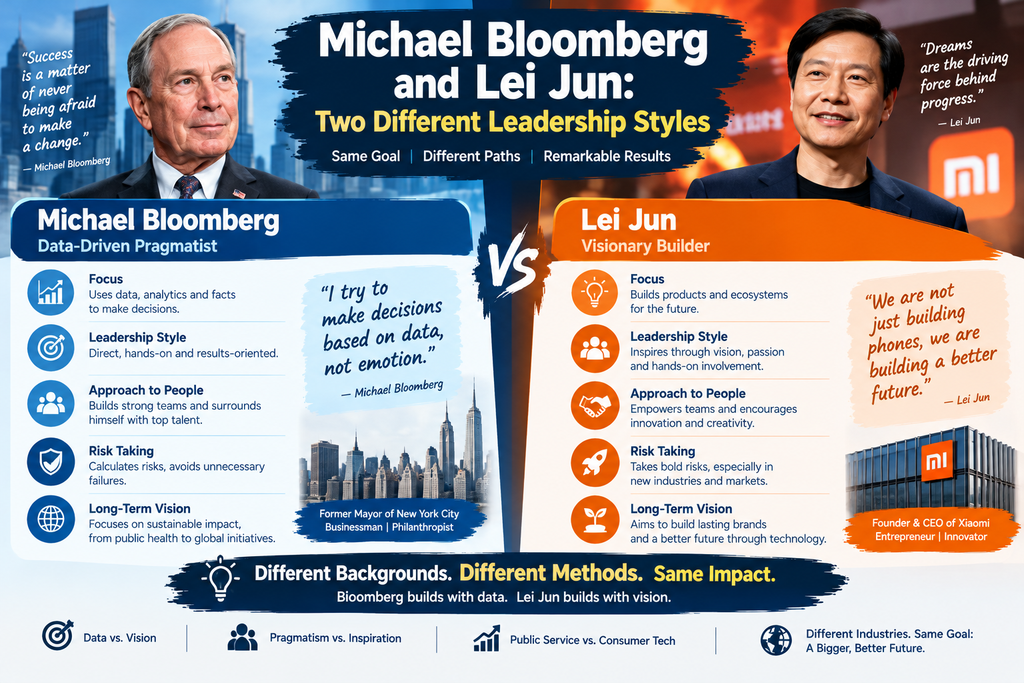
The contrast between these entrepreneurs becomes clearer when their leadership priorities are compared.
Bloomberg’s experience emphasizes data, financial information, operational discipline, and decision-making. His company serves professional customers who often require dependable systems and detailed analysis. In public office, he also emphasized measurable goals and administrative processes.
Lei Jun’s career emphasizes technology products, customer experience, market positioning, and ecosystem development. His business operates in consumer markets where design, pricing, brand reputation, and innovation can strongly influence purchasing decisions.
Neither approach is universally superior. The most effective leadership style depends on the industry, the customer, and the problem being solved.
A financial information company may prioritize accuracy, continuity, and specialized service. A consumer electronics company must also consider product appeal, manufacturing capacity, distribution, and rapid changes in consumer preferences.
Entrepreneurs can learn from both models by matching their leadership methods to the needs of their businesses rather than copying another executive’s style without considering context.
4. Seven Powerful Lessons From Their Success
The careers of Bloomberg and Lei Jun offer practical insights for anyone building a company or developing professional skills.
Lesson 1: Identify a Clear Market Need
Successful businesses often begin with a problem that customers genuinely want solved. Bloomberg recognized the importance of accessible financial information, while Lei Jun pursued opportunities in software and consumer technology.
Before launching a product, entrepreneurs should ask what problem it solves, who experiences that problem, and why existing alternatives may be insufficient.
Lesson 2: Use Experience to Make Better Decisions
Bloomberg’s Wall Street background helped him understand financial professionals. Lei’s experience in software and technology businesses gave him insight into product development and the technology market.
Experience does not guarantee success, but it can improve judgment when combined with research and a willingness to learn.
Lesson 3: Create Long-Term Customer Value
A business needs more than an attractive launch. It must continue delivering benefits that justify customers’ time and money.
Reliable services, product improvements, responsive support, and transparent communication can all strengthen customer relationships.
Lesson 4: Build a Business Model That Can Scale
Bloomberg developed a specialized information service for professional customers. Xiaomi expanded from smartphones into a wider range of connected products.
Scalability means growing without allowing costs, complexity, or declining quality to undermine the business. Growth should follow a repeatable model rather than depend entirely on short-term demand.
Lesson 5: Adapt to Industry Changes
Financial technology and consumer electronics both evolve rapidly. Businesses that ignore changing customer expectations or emerging competitors can lose their advantages.
Leaders should review market conditions, invest in relevant capabilities, and revise strategies when evidence suggests a better direction.
Lesson 6: Protect Trust and Reputation
Customers need confidence in the products and services they use. Bloomberg’s professional information business depends on usefulness and reliability, while Xiaomi’s consumer products depend on quality, support, and customer satisfaction.
Trust takes time to establish but can be damaged quickly by poor service, misleading claims, or unresolved problems.
Lesson 7: Think Beyond Immediate Profits
Bloomberg’s philanthropy shows how wealth and business influence can support initiatives beyond commercial operations. Lei Jun’s career illustrates the importance of developing technology products and businesses that can remain relevant as markets change.
For entrepreneurs, long-term thinking means considering employees, customers, product quality, sustainability, and the wider effects of business decisions.
5. Advantages and Disadvantages of Their Business Approaches
Both leaders achieved significant success, but their business models also involve trade-offs.
Bloomberg’s Model: Strengths and Risks
Advantages
- Specialized services can create strong customer relationships.
- Professional clients may value dependable information and integrated tools.
- Industry knowledge can help a company differentiate itself.
- Recurring demand can support long-term business planning.
Disadvantages and risks
- Dependence on a specialized market can expose a company to changing customer needs.
- Data services require continuous investment in technology and quality.
- Errors, outages, or declining trust can have serious consequences.
- Expansion into new markets may require different expertise and resources.
Bloomberg’s model shows the benefits of serving a defined audience, but specialization does not eliminate competitive or operational risk.
Lei Jun’s Model: Strengths and Risks
Advantages
- Competitive pricing can make technology accessible to more consumers.
- A connected product ecosystem can encourage repeat purchases.
- Product innovation can help a brand stand out.
- Expansion into related categories can create new revenue opportunities.
Disadvantages and risks
- Consumer electronics markets face intense price competition.
- Hardware businesses depend on complex manufacturing and supply chains.
- Fast product cycles can increase development and inventory costs.
- Software support, security, and product reliability must remain priorities.
Xiaomi’s broader ecosystem can create opportunities, but managing multiple product categories also increases operational complexity.
6. International Expansion, Business Regulations, and Market Challenges
Building a global business requires more than creating attractive products or delivering useful services. Companies must understand local regulations, consumer protection requirements, commercial agreements, and the legal environment in each market they enter.
This is particularly relevant when considering Lei Jun’s technology business and Xiaomi’s international expansion. Companies operating across borders may need to address different rules concerning product standards, data protection, intellectual property, distribution, and commercial partnerships.
For readers interested in the legal side of international business, the Chinese Law and CNLawBlog resource offers a relevant starting point for exploring Chinese legal topics. Understanding the regulatory environment can help businesses identify potential challenges before entering a new market or establishing partnerships.
Bloomberg’s business also illustrates the importance of operating within a complex professional environment. Financial information services must maintain reliable systems and respond to relevant market and regulatory requirements.
Entrepreneurs should therefore consider legal compliance and risk management as part of their business strategy, not as tasks to address only after a problem appears. When entering unfamiliar markets, qualified local legal and business advisers can help companies understand their obligations.
7. The Hidden Risks Behind Global Success

Public attention often focuses on the achievements of prominent entrepreneurs, but successful businesses face ongoing challenges that are less visible.
For Bloomberg’s business model, maintaining the accuracy and usefulness of financial information is essential. Changes in financial markets, technology, regulation, or customer expectations can affect how professional information services compete.
For Xiaomi, challenges include international competition, manufacturing costs, changing consumer preferences, product quality, and the need to maintain trust across an expanding ecosystem. New product categories may create opportunities, but they also require investment and careful execution.
Both leaders also demonstrate that business success and personal reputation are closely connected. Decisions involving employees, customers, public responsibilities, and corporate conduct can influence how a leader is remembered.
Aspiring entrepreneurs should evaluate the risks of growth alongside its potential rewards. A strong business is not simply one that expands quickly; it is one that can adapt, maintain customer confidence, and operate responsibly over time.
Frequently Asked Questions
1. Who are Michael Bloomberg and Lei Jun?
Michael Bloomberg is an American entrepreneur, philanthropist, and former New York City mayor who founded Bloomberg L.P. Lei Jun is a Chinese technology entrepreneur and the founder, chairman, and CEO of Xiaomi Corporation.
2. What is the main difference between their business strategies?
Bloomberg built a specialized financial information and media business serving professional customers. Lei Jun developed technology businesses focused on software, consumer electronics, and connected products.
3. What can entrepreneurs learn from Michael Bloomberg?
Entrepreneurs can learn to identify specific customer problems, use industry knowledge, develop dependable services, and create continuing value for customers.
4. What can entrepreneurs learn from Lei Jun?
Lei Jun’s career highlights customer-focused product development, competitive positioning, market adaptation, and the potential benefits of building a connected product ecosystem.
5. Why is understanding local law important for international businesses?
Local laws can affect product sales, intellectual property, data handling, contracts, and business partnerships. Understanding applicable requirements helps companies reduce legal risks and plan international expansion more effectively.
Conclusion
Michael Bloomberg and Lei Jun demonstrate two distinct paths to entrepreneurial success. Bloomberg built a global financial information business by addressing the needs of professional customers, then extended his influence into public service and philanthropy. Lei Jun developed a career in software and technology before helping build Xiaomi into a major consumer technology company.
Their experiences show that success does not depend on following a single business formula. It requires identifying meaningful opportunities, understanding customers, adapting to change, and managing risk.
The comparison of Michael Bloomberg and Lei Jun offers a valuable reminder for aspiring entrepreneurs: a strong business strategy should reflect the market being served, the problem being solved, and the capabilities of the organization. By combining innovation with discipline, regulatory awareness, and long-term thinking, business leaders can build companies that are better prepared for both opportunities and challenges.