



The Best AI Red Teaming Software helps organizations discover vulnerabilities, test AI behavior, and reduce security risks before deploying artificial intelligence systems. As businesses increasingly rely on AI chatbots, large language models (LLMs), and autonomous agents, protecting these systems has become an important part of cybersecurity.
Traditional security testing may not reveal every weakness in an AI application. A chatbot might expose confidential information, follow malicious instructions, or generate unsafe responses when confronted with carefully crafted prompts. AI red teaming helps security teams uncover these problems by simulating realistic attacks in a controlled environment.
Several tools can support this process, including Microsoft PyRIT, NVIDIA garak, and other AI security testing frameworks. Each option has different capabilities, technical requirements, and limitations.
In this guide, we explore seven AI red teaming software options and approaches, their advantages and disadvantages, and practical ways to choose the right solution for your organization.
What Is AI Red Teaming Software?
AI red teaming software helps security professionals test artificial intelligence systems against adversarial inputs and potentially harmful scenarios. Instead of checking only whether an AI application works as intended, these assessments investigate how it behaves when someone attempts to manipulate or misuse it.
For example, a company might deploy an AI assistant that answers questions using internal documents. During red team testing, a security researcher could attempt to make the assistant reveal confidential instructions or retrieve information the user should not access.
AI red teaming tools can help identify several types of weaknesses:
- Prompt injection: Attempts to manipulate an AI system through malicious instructions.
- Jailbreak attacks: Prompts designed to bypass a model’s safety restrictions.
- Sensitive data exposure: Attempts to reveal private or confidential information.
- Unsafe responses: Outputs that violate an organization’s policies.
- Unauthorized tool use: Attempts to manipulate AI agents into performing restricted actions.
- Reliability issues: Misleading, inaccurate, or inconsistent responses that create security or operational risks.
These tools can automate many tests, record results, and help developers reproduce vulnerabilities. However, automated testing is not enough on its own. Human review remains important for identifying complex weaknesses and understanding their real-world impact.
7 Best AI Red Teaming Software Tools to Consider
The right solution depends on your AI architecture, security objectives, technical expertise, and budget. The following seven options cover established testing frameworks, protective controls, and approaches for building a stronger AI security program.
1. Microsoft PyRIT
Microsoft PyRIT, or Python Risk Identification Tool, is an open-source framework designed for automated and human-led AI red teaming. It helps teams assess generative AI systems through configurable attack strategies, testing scenarios, and evaluation methods.
PyRIT supports single-turn and multi-turn assessments, making it useful for investigating attacks that develop across several interactions rather than a single prompt. Its CoPyRIT interface also supports interactive testing workflows.
Key features:
- Automated adversarial testing.
- Configurable attack strategies and scenarios.
- Support for different AI targets and endpoints.
- Assessment memory and results tracking.
- Flexible scoring and evaluation methods.
Advantages: PyRIT offers flexibility for security teams that need customized tests. Its extensible design supports repeatable assessments across different AI applications.
Disadvantages: Teams may need programming experience and time to configure meaningful test scenarios. Results also require careful interpretation.
Best for: AI security engineers, developers, and organizations building structured red teaming programs.
Official resource: Microsoft PyRIT documentation.
2. NVIDIA garak
NVIDIA garak is an open-source vulnerability scanner designed to test whether large language models can be manipulated into producing unwanted behavior. It uses different probes and detectors to investigate issues such as prompt injection, jailbreaks, data leakage, misinformation, and harmful content generation. <Cite refs={[“turn556757search0″,”turn556757search4”]}/>
Garak is particularly useful for teams that want a repeatable way to evaluate model weaknesses during development.
Key features:
- Automated vulnerability probes.
- Multiple testing and detection methods.
- Support for various model interfaces.
- Command-line workflows.
- Results that help teams investigate failures.
Advantages: Garak provides an accessible starting point for technical teams seeking open-source LLM security testing. Its modular approach also supports experimentation with different probes.
Disadvantages: It is primarily a technical tool, so nontechnical users may find its workflows challenging. Findings depend on the selected tests and require validation.
Best for: Developers, AI researchers, and security teams looking for an open-source LLM vulnerability scanner.
Official resource: NVIDIA garak on GitHub.
3. NVIDIA NeMo Guardrails
NVIDIA NeMo Guardrails is an open-source toolkit for implementing programmable guardrails in applications powered by large language models.
Unlike a dedicated red teaming scanner, NeMo Guardrails focuses on controlling AI interactions. Developers can use it to enforce conversational rules and add checks around inputs, outputs, and application behavior.
For example, a business might use red teaming to discover that a chatbot can provide prohibited information. Developers could then implement suitable guardrails and test whether those controls reduce the risk.
Key features:
- Configurable conversational rules.
- Input and output controls.
- Policy-based interaction management.
- Integration options for LLM applications.
- Customizable safeguards.
Advantages: It helps teams turn security findings into practical application controls and provides flexibility for developers.
Disadvantages: Guardrails cannot guarantee that every attack will be blocked. They require careful configuration and ongoing adversarial testing.
Best for: Developers who want to strengthen AI application safeguards alongside red teaming.
Official resource: NVIDIA NeMo Guardrails documentation.
4. Microsoft AI Red Team Resources

Microsoft’s AI Red Team resources provide methodologies, threat models, and guidance for assessing the security and safety of AI systems. They can help organizations understand how to plan an assessment and build a repeatable testing process. <Cite refs={[“turn556757search2”]}/>
These resources are especially useful for teams that need more than a scanning tool and want to establish clear procedures for identifying, documenting, and addressing AI risks.
Key features:
- AI red teaming methodologies.
- Guidance on threat modeling.
- References for AI security and safety.
- Resources for building internal red teams.
- Connections to tools such as PyRIT.
Advantages: The guidance can help organizations develop a consistent approach to AI security testing and prioritize relevant threats.
Disadvantages: Documentation and methodologies do not replace a complete scanning platform. Teams still need to select tools, configure tests, and assess their own systems.
Best for: Organizations developing an internal AI security program or improving their existing testing procedures.
Official resource: Microsoft AI Red Team.
5. Garak-Based Custom Testing Workflows
Teams can extend garak or combine it with their own scripts and evaluation datasets to create custom AI security testing workflows.
This approach is useful when a general-purpose scanner does not cover all the risks associated with a particular application. A customer support assistant, for example, may need specific tests for unauthorized account information disclosure.
Key features:
- Custom testing scenarios.
- Repeatable vulnerability checks.
- Adaptable model configurations.
- Integration with development workflows.
- Application-specific assessment coverage.
Advantages: Custom workflows allow teams to focus on risks that matter most to their applications. They can also support regression testing after fixes.
Disadvantages: Creating and maintaining custom tests requires engineering effort. Poorly designed scenarios can produce incomplete coverage or misleading results.
Best for: Teams with technical expertise that need tailored LLM security checks.
6. PyRIT-Based Continuous AI Security Testing
Organizations can incorporate PyRIT assessments into development and testing pipelines to evaluate AI systems repeatedly as they change.
For example, a company could run a defined set of adversarial tests whenever it updates a model, modifies a system prompt, changes retrieval settings, or introduces a new AI agent capability.
Key features:
- Repeatable adversarial assessments.
- Configurable testing scenarios.
- Regression testing after fixes.
- Results tracking across test runs.
- Integration into broader development workflows.
Advantages: Regular assessments can help teams identify regressions before changes reach production. They also encourage developers to treat AI security as an ongoing responsibility.
Disadvantages: Continuous testing requires maintenance, reliable test cases, and appropriate thresholds for evaluating failures. Not every test needs to run on every code change.
Best for: Engineering teams that already use automated testing and want to include AI-specific security checks.
7. Custom AI Red Teaming Frameworks
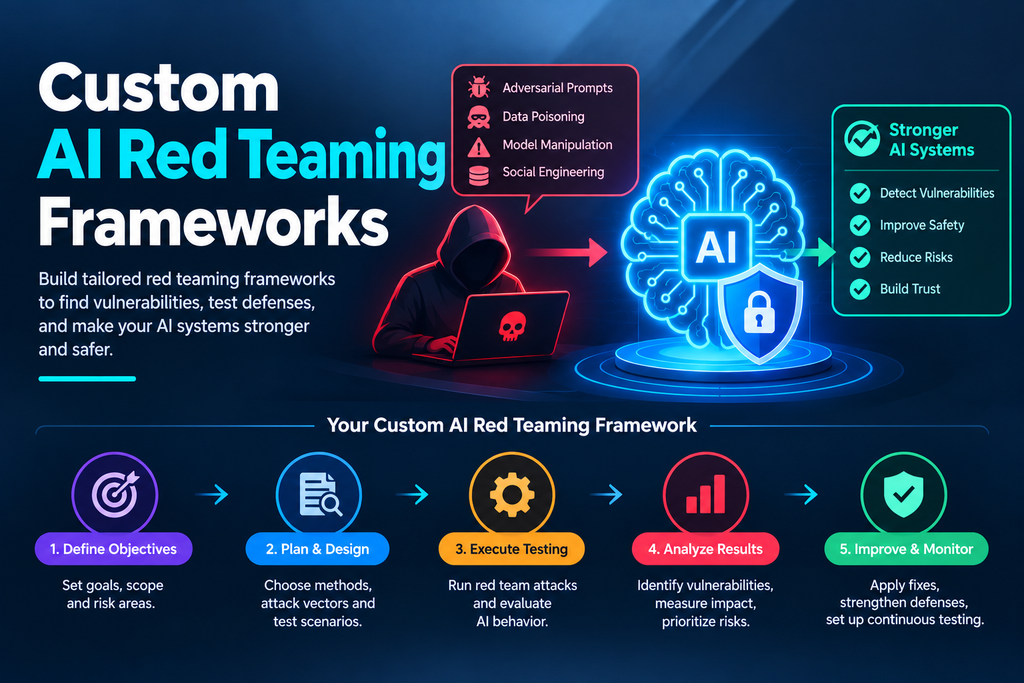
Some organizations build a dedicated internal framework using model APIs, test datasets, scripts, logging systems, and human evaluation.
A custom framework can be valuable when an application has unusual requirements. For instance, an AI assistant connected to company documents may need tests that examine access permissions, document retrieval, and whether confidential information can leak across user sessions.
Key features:
- Tailored attack scenarios.
- Custom scoring and reporting.
- Integration with existing security systems.
- Control over testing requirements.
- Coverage for specialized AI workflows.
Advantages: Custom frameworks can address business-specific threats that general-purpose tools may not fully cover.
Disadvantages: Development and maintenance costs can be significant. Teams must keep test scenarios current and ensure that results remain meaningful as the AI system evolves.
Best for: Organizations with specialized AI systems and established security engineering teams.
How to Choose the Best AI Red Teaming Software
Choosing the right solution starts with understanding what you need to protect. A general-purpose chatbot, an AI-powered search assistant, and an agent that can execute business actions have different risk profiles.
Identify your biggest security risks
List the sensitive information, important functions, and external tools your AI application can access. Determine whether your main concerns involve prompt injection, jailbreaks, data exposure, harmful outputs, or unauthorized actions.
Prioritize tools that can test the risks most relevant to your system.
Check model compatibility
Confirm whether a tool supports your model provider, deployment environment, API configuration, and application architecture. If your system uses retrieval-augmented generation (RAG), assess the full workflow rather than testing only the underlying model.
Review automation and reporting
Good reporting should show the test scenario, input, model response, detected issue, and enough detail to reproduce the result. This makes it easier for developers to fix vulnerabilities and verify their fixes.
Compare costs and technical requirements
Open-source software may reduce licensing costs, but it can still require infrastructure, model API usage, maintenance, and engineering time. Commercial products may offer managed services or convenient reporting, but capabilities and prices vary.
Evaluate the total cost of operating the solution, not just the purchase price.
Run a practical trial
Test shortlisted tools in an authorized, nonproduction environment. Use a consistent set of test cases to compare coverage, usability, reporting quality, and the effort required to investigate findings.
Advantages and Disadvantages of AI Red Teaming Software
AI red teaming software can improve security testing, but it also has limitations that organizations should understand.
Major advantages
- Earlier vulnerability discovery: Identify weaknesses before they cause problems in production.
- Repeatable testing: Run similar assessments after model, prompt, or code changes.
- Broader test coverage: Explore many adversarial inputs more efficiently.
- Better collaboration: Share documented findings with developers and security teams.
- Stronger risk management: Use results to improve safeguards, permissions, and monitoring.
Potential disadvantages
- Incomplete coverage: No tool can guarantee that every vulnerability will be discovered.
- False positives: Some reported issues may not represent meaningful security risks.
- Missed vulnerabilities: Automated tests may fail to detect context-dependent weaknesses.
- Technical complexity: Some frameworks require programming and security expertise.
- Ongoing maintenance: Attack methods and AI application behavior change over time.
These limitations do not make red teaming ineffective. They show why tools should be combined with human-led assessment, secure development practices, and continuous monitoring.
Best Practices for Securing AI Systems
A useful AI red teaming program should follow a structured process.
1. Define the scope. Identify the AI models, applications, APIs, data sources, and connected tools that are authorized for testing.
2. Establish a baseline. Record the system’s current behavior so future assessments can identify improvements or regressions.
3. Test realistic attacks. Include prompt injection, jailbreak attempts, data exposure, unsafe responses, and unauthorized tool use where relevant.
4. Validate findings. Reproduce important failures and determine their actual security impact before assigning severity.
5. Prioritize fixes. Address vulnerabilities according to their likelihood, impact, and the level of access an attacker could gain.
6. Retest after remediation. Confirm that fixes work and preserve successful attack cases in your regression test suite.
7. Repeat assessments regularly. Changes to models, prompts, retrieval sources, permissions, or integrations can introduce new vulnerabilities.
Organizations can also consult the NIST AI Risk Management Framework resources for additional guidance on managing AI-related risks.
For businesses planning long-term operational resilience, business succession planning attorney is a separate resource relevant to ownership transitions and continuity planning. Although it is not an AI security guide, business continuity is another consideration for organizations managing critical operations.
Frequently Asked Questions
What is the best AI red teaming software?
The best choice depends on your needs. Microsoft PyRIT offers flexible red teaming workflows, while NVIDIA garak focuses on scanning language models for vulnerabilities. Choose based on compatibility, testing coverage, and technical requirements.
Is AI red teaming software free?
Some tools, including PyRIT and garak, are open source. However, operating them may involve model API fees, infrastructure expenses, and engineering time. Review each project’s current license and requirements.
Can AI red teaming tools prevent prompt injection?
They can help identify prompt-injection weaknesses, but detection alone does not prevent attacks. Effective protection may require access controls, input and output validation, restricted tool permissions, secure retrieval design, and monitoring.
How often should AI systems be red teamed?
Assess AI systems before important deployments and after significant changes to models, prompts, data sources, or permissions. Higher-risk applications may require more frequent testing.
Are automated AI security tests enough?
No. Automated tools can improve coverage and repeatability, but human review is important for understanding context, validating findings, and identifying complex attack paths.
Conclusion
The Best AI Red Teaming Software depends on your organization’s security needs, technical expertise, and AI architecture. Microsoft PyRIT is a flexible choice for automated and human-led assessments, while NVIDIA garak provides an open-source approach to LLM vulnerability scanning. NeMo Guardrails can help developers implement protective controls, and custom workflows can address specialized risks.
Before choosing a solution, evaluate its compatibility, test coverage, reporting capabilities, and total operating cost. Combine automated assessments with human review, access controls, and regular retesting to address vulnerabilities more effectively.
AI security is not a one-time task. By making red teaming part of the development lifecycle, organizations can identify weaknesses earlier, reduce avoidable risks, and build more reliable AI systems.