



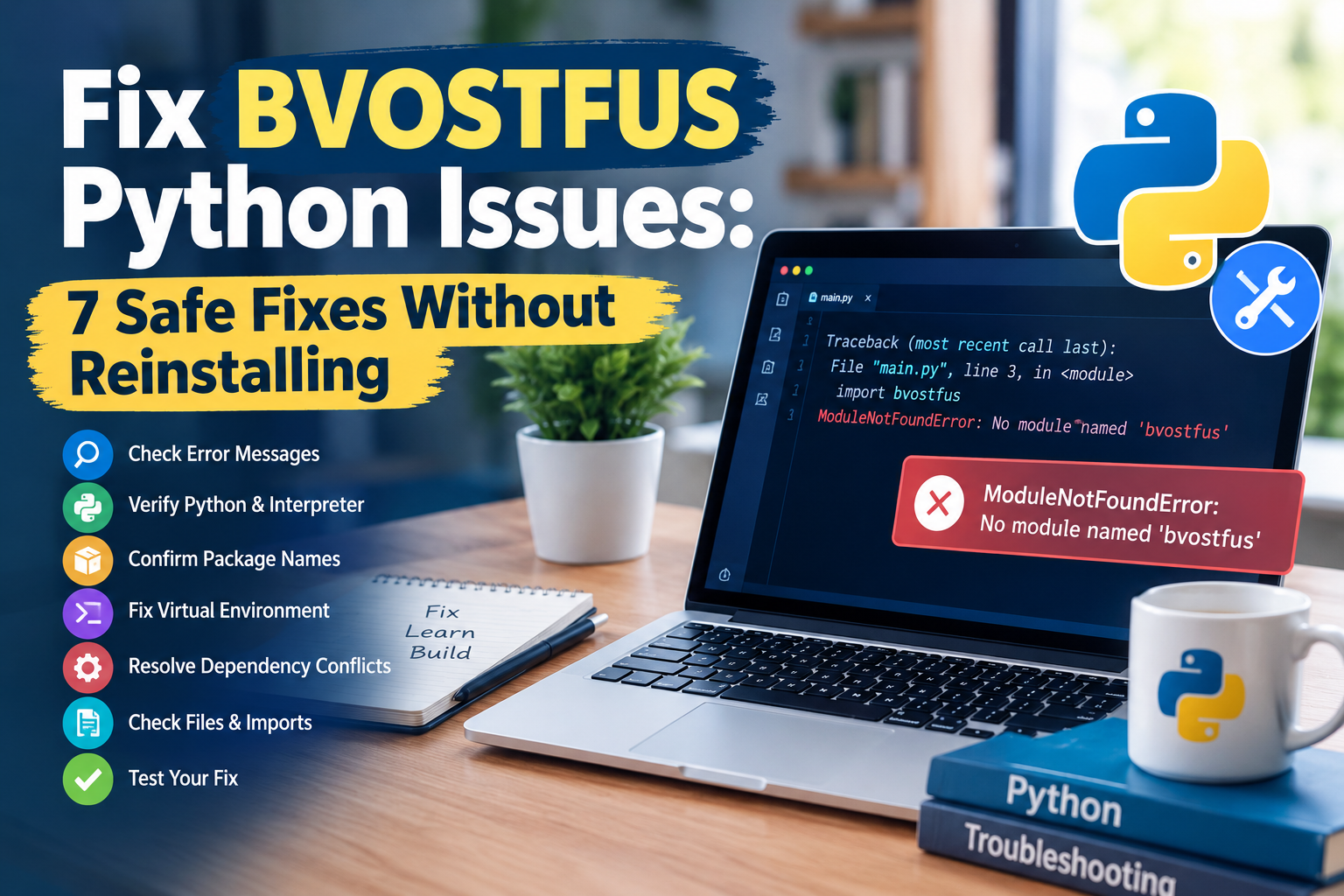
Python errors can interrupt a project, delay development, and make even simple tasks frustrating. If you are searching for ways to Fix BVOSTFUS Python Issues: without reinstalling Python, the best approach is to identify the actual cause before changing your setup. The term “BVOSTFUS” does not appear to be a standard Python feature, so the issue may involve a package name, an import error, a project configuration, or a message generated by a particular application.
The good news is that many Python problems can be resolved without removing Python or reinstalling everything. Checking the error message, verifying your interpreter, repairing a virtual environment, and reviewing dependencies can often restore your project.
This guide explains seven practical troubleshooting methods, common mistakes to avoid, and ways to check whether your fix has worked.
What Does the BVOSTFUS Python Issue Mean?
Before applying a solution, understand what the error actually indicates. “BVOSTFUS” is not a commonly recognized Python command or standard-library module. It could be a project-specific name, a third-party component, a typo, or a term displayed by another tool.
The correct fix depends on the complete error message. For example:
- ModuleNotFoundError: Python cannot find a requested module.
- ImportError: A module or one of its components cannot be imported.
- SyntaxError: Python cannot parse the code.
- PermissionError: The program lacks permission to access a file or resource.
- Dependency conflict: Installed packages require incompatible versions.
- Interpreter mismatch: Your editor or terminal is using a different Python installation.
Do not assume that reinstalling Python—or installing a package with the same name as the error—is the right solution. Start by collecting evidence.
1. Read the Complete Python Error Message
The first step is to examine the full traceback. Python usually provides useful information about where an error occurred and which operation failed.
Look for the final lines of the traceback. These often contain the exception type and a short explanation. Also note the filename and line number associated with the error.
For example, an error such as ModuleNotFoundError: No module named ‘example_module’ suggests that Python cannot locate an import. It does not automatically mean that Python itself is damaged.
Try these steps:
- Run the program again and copy the complete traceback.
- Identify the final exception type.
- Check which file and line triggered the error.
- Look for recent code changes or package updates.
- Search the exact error text in the official documentation or the relevant project’s documentation.
If BVOSTFUS appears in a third-party application’s message, check that application’s logs and documentation as well. The name may belong to the application rather than Python.
Why this works: A traceback helps distinguish a code problem from an environment or dependency problem, reducing the risk of making unnecessary changes.
2. Verify Your Python Version and Interpreter
One common reason a Python project fails is that the terminal, code editor, and application use different Python interpreters. A package may be installed successfully but remain unavailable to the interpreter running your script.
Open a terminal and run:
python –version
If that command is not recognized or points to another installation, try:
python3 –version
Next, identify the interpreter being used:
python -c “import sys; print(sys.executable)”
On Windows, the Python launcher can also help you inspect installed versions:
py -0p
Compare the results with the interpreter selected in your code editor. In Visual Studio Code, for example, check the selected Python interpreter and ensure it matches the environment where your project’s packages are installed.
If you discover a mismatch, select the correct interpreter rather than reinstalling Python.
Important: Use the command that matches your system and project setup. Some computers use python, while others use python3 or the Windows py launcher.
3. Verify the Package Name Before Installing Anything
If the error mentions BVOSTFUS or another unfamiliar module, confirm whether it is a real dependency of your project.
Python imports and package distribution names are not always identical. A package might be installed under one name but imported using another. Some modules are also included in Python’s standard library and do not require a separate installation.
Start by checking:
- The project’s requirements.txt file.
- Its pyproject.toml or other dependency configuration.
- The project’s README or official installation instructions.
- The package’s official documentation or repository.
- The Python Package Index (PyPI), which lists many published Python packages.
Avoid running a guessed command such as pip install bvostfus unless the project’s documentation confirms that this is the correct package.
If a dependency is confirmed, install it through the same interpreter that runs your program:
python -m pip install package_name
Replace package_name with the verified package name.
This approach helps prevent accidental installation of unrelated packages and reduces confusion between multiple Python environments.
4. Repair or Recreate Your Virtual Environment
A virtual environment keeps project dependencies separate from other Python projects. If an environment is missing packages or contains incompatible dependencies, repairing it may solve the problem without reinstalling Python globally.
First, check whether your project already has a virtual environment. Common folder names include .venv and venv.
On Windows, activate an existing environment with:
.venv\Scripts\activate
On macOS or Linux, use:
source .venv/bin/activate
If your project uses a different environment folder, replace .venv with its actual name.
Then verify the interpreter and check the dependencies:
python –version
python -m pip –version
python -m pip check
If the environment is seriously damaged, creating a fresh one may be safer than changing your global Python installation. First record your project’s dependencies and preserve any necessary configuration.
For example:
python -m venv .venv-new
Activate the new environment using the appropriate command for your operating system, then install the project’s documented dependencies.
Consult the official Python tutorial on virtual environments for platform-specific guidance.
Keep in mind that recreating an environment is different from reinstalling Python. It gives the project a clean, isolated dependency setup while leaving the main installation in place.
5. Check for Dependency Conflicts

A Python project may stop working after a package update, especially when two dependencies require incompatible versions of another library.
Run:
python -m pip check
This command checks installed packages for declared dependency conflicts. If it reports a problem, read the package names and version requirements carefully.
Next, review your project’s dependency file. If the application previously worked, check whether a recent package upgrade or dependency change coincided with the failure.
Use these practices:
- Install dependencies listed in the project’s official configuration.
- Follow documented version requirements.
- Avoid upgrading every package at once.
- Keep a record of changes so you can reverse them.
- Test the application after changing one dependency at a time.
If the project uses a lockfile or a documented dependency-management tool, follow that project’s workflow to restore compatible versions.
Do not automatically downgrade or upgrade unrelated packages. A change that fixes one import error could create another conflict elsewhere.
6. Check File Names, Imports, and Project Paths
Sometimes the problem is in the project folder rather than the Python installation. A local file can accidentally have the same name as a standard-library module or a third-party package.
For example, naming a script json.py, random.py, or requests.py can interfere with imports in certain situations. Python may load the local file instead of the intended module.
To investigate:
- Check whether a project file has the same name as the module you are importing.
- Rename conflicting files when necessary.
- Remove related __pycache__ files or folders after renaming, if stale cached files are contributing to the issue.
- Confirm that the script is running from the expected project directory.
- Check whether the imported module exists in the correct environment.
You can inspect Python’s module search paths with:
python -c “import sys; print(‘\n’.join(sys.path))”
Be careful when changing paths manually. If a path is missing, first determine why the project is running from the wrong location or environment.
Python is also used in technical workflows beyond conventional software development. For example, automation and data-processing tools can support modern construction workflows. You can explore this broader context in Urbansplatter’s guide to what construction technology is. When troubleshooting a Python tool used in such a workflow, identifying the specific application and its dependencies can help narrow down the cause.
7. Test the Fix Before Returning to Your Project

After making a change, verify that Python still runs and that the affected module can be imported.
Start with a basic test:
python -c “print(‘Python is working’)”
If the issue involves a specific module, test that import separately:
python -c “import module_name; print(‘Import successful’)”
Replace module_name with the actual import name confirmed by your project’s documentation.
If the test succeeds, run the original program again. Check whether the same error appears and whether any new errors have replaced it.
For a larger application, test the smallest affected component before running the entire workflow. This makes it easier to determine whether the fix addressed the original cause.
If the problem remains, collect the following details:
- Your operating system.
- The output of python –version.
- The exact command used to run the program.
- The full traceback.
- The relevant dependency or import name.
- The steps you have already tried.
These details make it easier to identify a specific solution without resorting to a complete reinstall.
Advantages and Limitations of Fixing Python Without Reinstalling
Advantages
- Saves time: Most diagnostic checks take only a few minutes.
- Protects existing projects: You can avoid disrupting unrelated environments.
- Reduces configuration loss: Global settings and installed tools can remain intact.
- Improves troubleshooting skills: You learn to identify the actual source of errors.
- Limits unnecessary changes: Targeted fixes reduce the risk of creating new problems.
Limitations
- Some installations may be damaged: A severely corrupted Python installation can require repair or replacement.
- Third-party software may need its own fix: An error generated by another application may not be resolved through Python commands.
- Compatibility issues can be complex: Projects with many dependencies may require careful version management.
- The exact error matters: Without the full traceback, no single solution can be guaranteed.
The goal is not to avoid reinstalling Python at all costs. It is to try safe, targeted fixes first and reinstall only when the evidence suggests it is necessary.
Frequently Asked Questions
What is BVOSTFUS in Python?
BVOSTFUS is not a commonly recognized standard Python feature. It may be a project-specific identifier, a third-party component, a typo, or an error label from another application. Check the full traceback and the documentation for the software where it appears.
Can I fix BVOSTFUS Python issues without reinstalling Python?
Often, yes—if the underlying cause is a missing dependency, incorrect interpreter, virtual-environment problem, conflicting package, or import-path issue. The correct solution depends on the actual error message.
Should I install a package called BVOSTFUS?
Do not install an unfamiliar package solely because its name appears in an error. First confirm the package name and source through your project’s documentation, trusted repository, or the Python Package Index.
Will creating a virtual environment delete my existing Python installation?
No. Creating a virtual environment normally creates an isolated project environment without removing your main Python installation. However, check your commands and paths before deleting or replacing any existing environment.
When should I reinstall Python?
Consider repairing or reinstalling Python if core files are corrupted, the interpreter consistently fails to start, or standard troubleshooting cannot resolve a confirmed installation problem. Back up important project files and settings first.
Conclusion
You can often Fix BVOSTFUS Python Issues: without reinstalling Python by investigating the full traceback, checking the active interpreter, verifying package names, repairing a virtual environment, resolving dependency conflicts, and checking imports and file paths.
Start with the least disruptive checks and test each change before moving to the next. Because BVOSTFUS is not a commonly recognized standard Python term, avoid assuming that a particular package or installation is responsible without further evidence.
If these steps do not resolve the issue, use the complete error message and your environment details to investigate the specific cause. A targeted diagnosis is usually more effective—and safer—than reinstalling Python as the first step.