



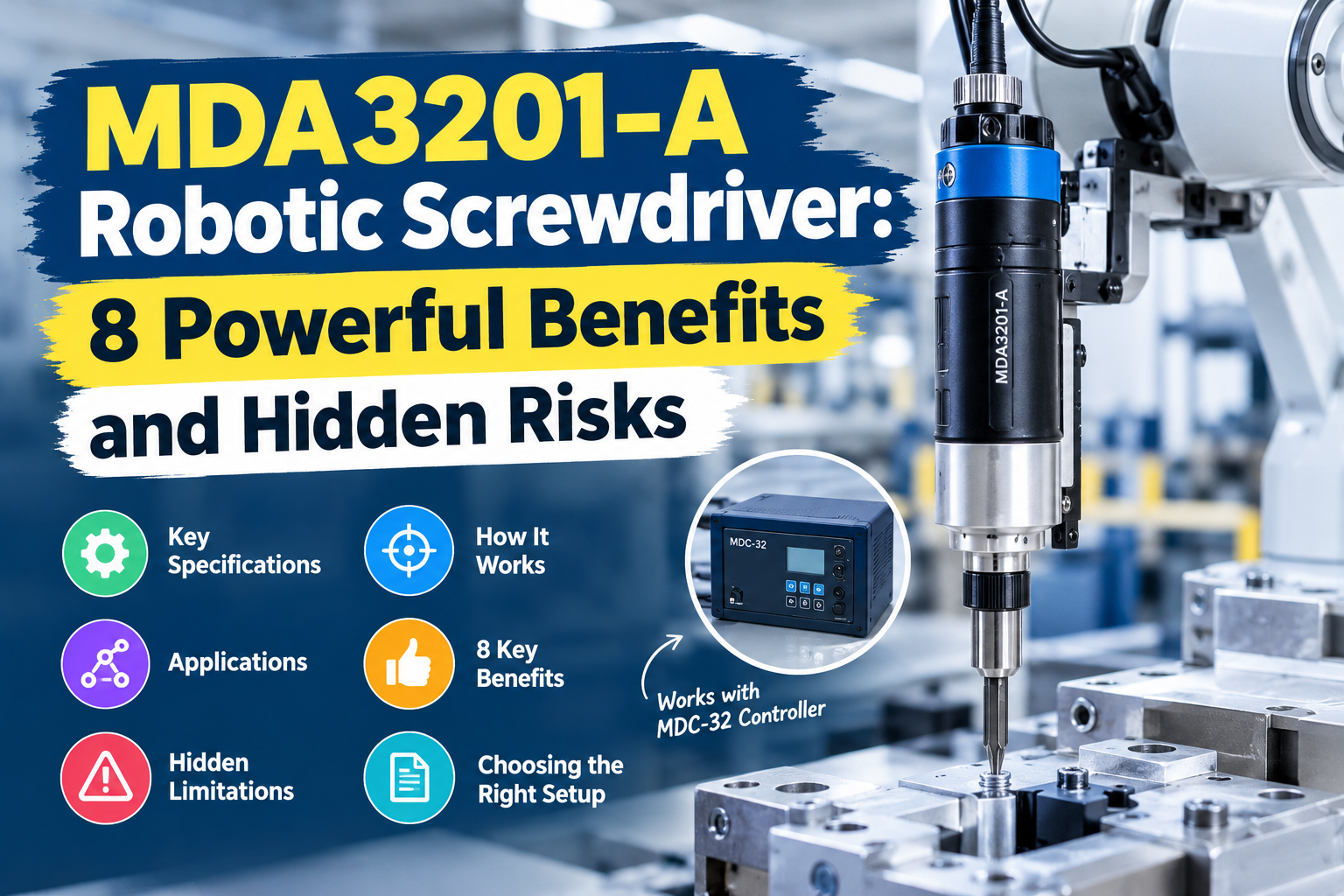
The MDA3201-A Robotic Screwdriver is an electric fastening tool designed for automated assembly applications that require consistent torque, repeatable performance, and reliable process control. It is built for integration with compatible automation equipment and operates with an MDC-32 controller.
Manufacturers can use this type of screwdriver to improve fastening consistency, support production monitoring, and reduce repetitive manual work. However, its torque range, integration requirements, and operating limitations should be evaluated before choosing it for a production line.
This guide explains the MDA3201-A Robotic Screwdriver’s operating principle, key specifications, practical applications, eight major benefits, and potential limitations to help you make an informed decision.
What Is the MDA3201-A Robotic Screwdriver?
The MDA3201-A Robotic Screwdriver is an automated electric screwdriver spindle intended for industrial screw-fastening operations. It is designed to work as part of an assembly system rather than as an ordinary handheld screwdriver.
The tool uses an electric motor to rotate a compatible fastening bit. When connected to the appropriate controller and automation equipment, it can be used in a programmed fastening process.
Its main purpose is to help manufacturers perform repeatable screw-tightening operations in applications where fastening quality, production speed, and process consistency matter.
The tool may be suitable for electronics, small mechanical assemblies, electrical equipment, and other products requiring relatively low fastening torque. Actual suitability depends on the screw type, joint design, materials, and required torque.
MDA3201-A Robotic Screwdriver Specifications
Understanding the specifications is essential before integrating the screwdriver into a production environment.
| Specification | Details |
| Model | MDA3201-A |
| Tool type | Robotic electric screwdriver spindle |
| Torque range | 0.1–1.17 Nm |
| Speed range | 150–2,000 RPM |
| Drive size | 1/4-inch female hex |
| Compatible controller | MDC-32 |
| Listed tool weight | Approximately 0.675 kg |
| Main purpose | Automated screw fastening |
These specifications are based on available product information for the MDA3201-A model. Check the exact model documentation and configuration before purchasing, particularly if your process requires specific accuracy, communication, or traceability functions.
For additional product details, see the MDA3201-A Robotic Screwdriver product listing. You can also review the manufacturer’s MD3201-A electric screwdriver specifications for related technical information.
How Does the MDA3201-A Robotic Screwdriver Work?
The MDA3201-A Robotic Screwdriver works through a controlled electric fastening process. The screwdriver is mounted in suitable equipment, aligned with a screw, and operated using the required controller and programmed sequence.
1. Positioning and Alignment
The automation system positions the screwdriver above the screw. Correct alignment helps prevent damaged screw heads, cross-threading, and poor joint quality.
The mounting arrangement must provide sufficient access to the fastening point and maintain the required position throughout the operation.
2. Starting the Fastening Cycle
Once the screw and workpiece are correctly positioned, the control system initiates the fastening cycle according to the configured setup.
The electric motor rotates the bit to drive the screw into the joint. The selected settings should match the screw size, material, and assembly requirements.
3. Controlling Torque and Speed
Torque determines the rotational force applied during fastening, while speed affects how quickly the screw is driven. The MDA3201-A has a listed torque range of 0.1–1.17 Nm and a speed range of 150–2,000 RPM.
Correct settings help reduce the risk of loose joints, stripped threads, and damage to delicate components.
4. Monitoring the Process
The compatible MDC-32 controller supports the tool’s operation and can provide process-management functions depending on the configured system. Features such as programmable fastening settings and data collection should be verified against the specific controller configuration.
5. Completing the Operation
After the fastening sequence finishes, the automation system can move to the next assembly step. Manufacturers should validate the cycle, inspect sample joints, and confirm that the completed fasteners meet their quality requirements.
Understanding the wider role of automation and control systems can also help when planning integration. Read this related guide on what control technology is used for.
8 Powerful Benefits of the MDA3201-A Robotic Screwdriver
1. Consistent Fastening Results
Manual screw tightening can vary with operator technique, fatigue, and working conditions. A properly configured electric screwdriver can help make repeated fastening operations more consistent.
This is especially useful in production environments where many similar products must be assembled to the same standard.
2. Support for Automated Assembly
The MDA3201-A is designed for automation applications. When integrated with compatible equipment, it can perform repetitive fastening tasks as part of a programmed production sequence.
This can help manufacturers standardize operations and reduce reliance on manual screw-driving at repetitive workstations.
3. Programmable Torque Control
The listed torque range of 0.1–1.17 Nm makes the screwdriver suitable for applications that require relatively low fastening torque.
Using appropriate settings can help protect sensitive components and improve joint consistency. However, the required torque must be determined from the product’s engineering specifications and verified through testing.
4. Flexible Operating Speed
With a listed speed range of 150–2,000 RPM, the tool can support different fastening requirements within its operating limits.
The correct speed depends on the screw, material, joint design, and desired cycle time. Running at the highest speed is not always the best option because excessive speed may affect fastening quality.
5. Controller-Based Process Management
The MDC-32 controller is required for operation. Depending on the configuration, it supports programmed fastening processes and related control functions.
A suitable controller setup can make it easier to manage repeatable production tasks and adjust settings when product requirements change.
6. Potential for Better Traceability
Manufacturers may need to monitor fastening results to support quality assurance and investigate production defects.
The compatible control system offers process-related functions, but the precise data available depends on the installed configuration. Confirm the required records, communication interfaces, and monitoring features before implementation.
7. Reduced Repetitive Manual Work
Automating repetitive screw fastening can reduce the amount of manual work required at a workstation. Employees may then focus on inspection, material handling, or other tasks that require human judgment.
The actual labor savings depend on production volume, cycle time, equipment cost, and the complexity of the integration.
8. Potential Production Efficiency Improvements
A well-designed automated fastening process can reduce variation and help maintain a predictable workflow. Consistent cycles may also make production planning easier.
These improvements are not automatic. They depend on correct setup, suitable tooling, regular maintenance, and a validated fastening process.
Common Applications of the MDA3201-A Robotic Screwdriver
The MDA3201-A may be useful in production environments where the required torque, tool access, and fastening process match its specifications.
Common potential applications include:
- Electronics assembly: fastening suitable enclosures and small components.
- Electrical equipment: tightening screws in compatible housings and assemblies.
- Small mechanical products: assembling parts that require controlled, low-torque fastening.
- Automated production lines: incorporating screw fastening into a programmed sequence.
- Repeated batch manufacturing: standardizing fastening operations across similar products.
These are potential applications rather than guaranteed compatibility claims. Manufacturers should test the screwdriver with their actual screws, workpieces, and fastening requirements before using it in production.
Hidden Limitations to Consider Before Buying
Although the MDA3201-A offers useful automation capabilities, it is not suitable for every application.
Limited Torque Range
The maximum listed torque is 1.17 Nm. Applications requiring higher torque may need a different model. Selecting a tool with insufficient torque can result in improperly secured joints.
Dependence on the Compatible Controller
The screwdriver requires an MDC-32 controller. Buyers should account for the controller, cables, mounting arrangements, automation programming, and any additional communication equipment required.
Integration Complexity
A robotic screwdriver must be aligned and configured correctly within the overall system. Poor positioning or incorrect settings can cause fastening defects even when the tool itself is functioning properly.
Maintenance and Quality Checks
Automated tools still require inspection, suitable replacement bits, and routine maintenance. Production teams should establish a maintenance schedule and verify fastening quality regularly.
Application-Specific Compatibility
Not every screw, material, or joint is suitable for this model. Test the actual assembly and confirm that the torque range, speed, access, and required quality controls meet the application’s needs.
How to Choose the Right Robotic Screwdriver
Before purchasing the MDA3201-A, evaluate the following factors:
- Required torque: Make sure the application’s required torque falls within 0.1–1.17 Nm.
- Speed requirements: Check whether the 150–2,000 RPM range supports your target cycle time.
- Controller compatibility: Confirm the MDC-32 setup and any required communication interfaces.
- Mounting and accessibility: Verify that the screwdriver can reach each fastening point without interference.
- Quality and traceability: Determine what monitoring, records, and inspection procedures your production process requires.
- Total ownership cost: Include integration, accessories, training, maintenance, and replacement bits.
- Production testing: Validate fastening results on real workpieces before approving the tool for routine use.
A careful assessment can help prevent unnecessary costs and ensure that the selected screwdriver fits the production process.
Frequently Asked Questions
What is the torque range of the MDA3201-A Robotic Screwdriver?
The listed torque range is 0.1–1.17 Nm. Confirm the specifications for the exact model and configuration before use.
What is the maximum speed of the MDA3201-A?
The listed maximum speed is 2,000 RPM, with an operating range of 150–2,000 RPM.
Which controller does the MDA3201-A require?
The MDA3201-A operates with the MDC-32 controller. Check the manufacturer’s documentation for the necessary cables and integration requirements.
Can the MDA3201-A be used in automated assembly?
Yes. It is designed for automation applications and can be integrated into a suitable system after mechanical, electrical, control, and safety requirements are reviewed.
Is the MDA3201-A suitable for high-torque fastening?
It is suitable only when the required torque falls within its specified range. For applications requiring more than 1.17 Nm, consider a model with a higher torque capacity.
Conclusion
The MDA3201-A Robotic Screwdriver is designed for automated fastening tasks that require controlled, repeatable performance within a relatively low torque range. Its listed specifications include 0.1–1.17 Nm torque, 150–2,000 RPM speed, a 1/4-inch female hex drive, and compatibility with the MDC-32 controller.
Its key benefits include consistent fastening potential, automation support, programmable process control, and opportunities to improve production efficiency. However, controller requirements, integration complexity, maintenance, and torque limitations should be assessed before purchasing.
The best choice is one that meets the actual requirements of your assembly process. Verify the specifications, test the tool with real components, and confirm the complete system’s performance before introducing it into production.