



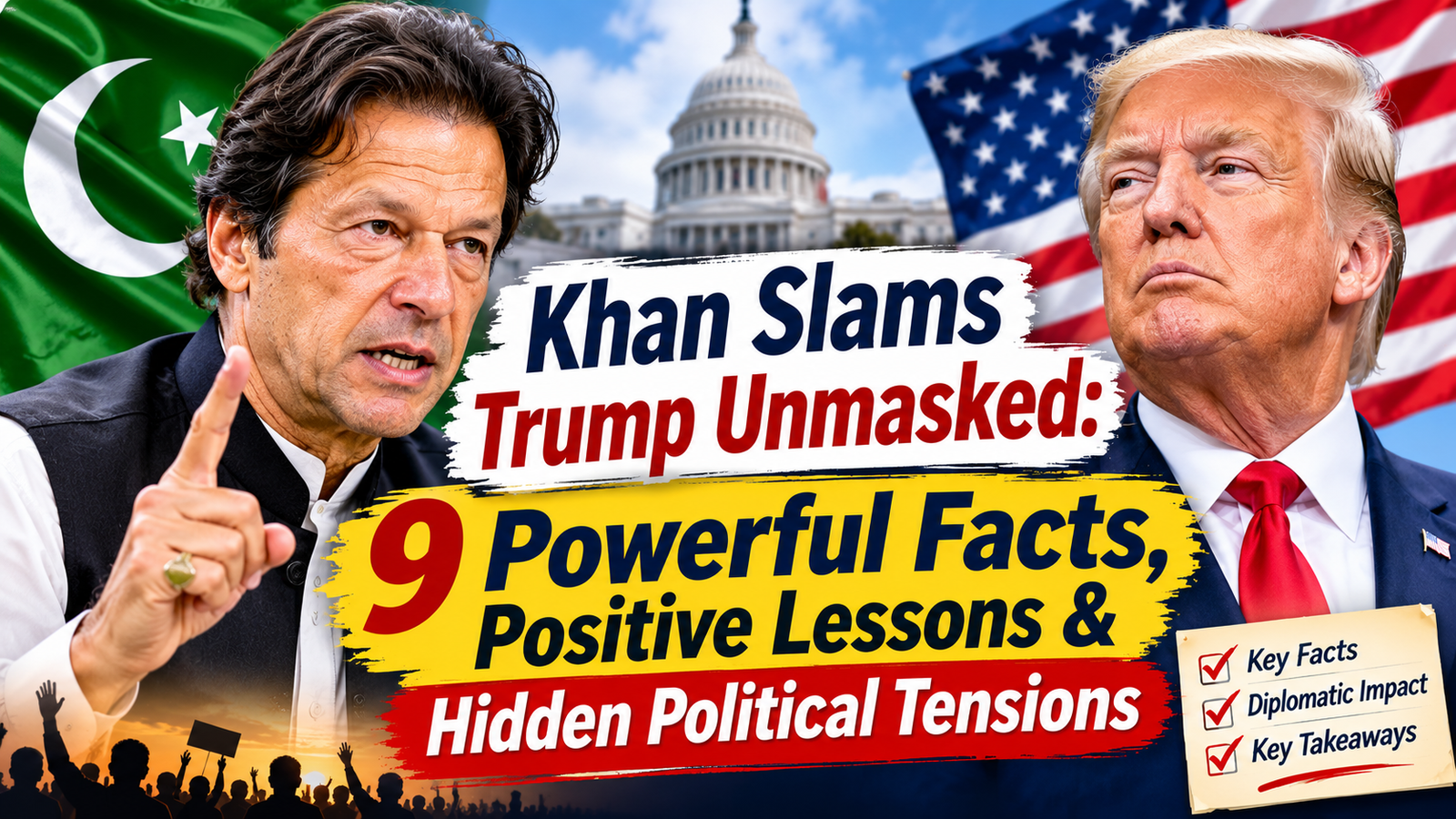
Khan Slams Trump Unmasked describes a major political disagreement between former Pakistani Prime Minister Imran Khan and former US President Donald Trump in November 2018. The dispute attracted international attention after Trump criticized Pakistan’s cooperation with the United States and questioned its role in the fight against terrorism.
Imran Khan responded publicly, arguing that Pakistan had made enormous human and economic sacrifices during the US-led War on Terror. He also challenged Trump’s statements about Afghanistan, American financial assistance, and Osama bin Laden’s presence in Pakistan.
However, the disagreement did not begin with one interview or social media post. It reflected years of tension between Washington and Islamabad over security, military cooperation, regional politics, and mutual expectations.
This article explores Khan Slams Trump Unmasked through nine important facts. It explains what happened, why both leaders disagreed, how Pakistan responded, and what the controversy revealed about international relationships.
1. Trump’s January 2018 Statement Started a New Wave of Tension
The background to Khan Slams Trump Unmasked goes back to January 1, 2018. Donald Trump began the year by publicly criticizing Pakistan on social media.
He claimed that the United States had provided Pakistan with more than $33 billion in assistance over 15 years but had received what he described as lies and deceit in return. He also accused Pakistan of providing safe havens to terrorists operating in Afghanistan.
These comments created an immediate diplomatic reaction in Pakistan. Government representatives rejected the accusations and questioned the way American assistance and Pakistan’s security cooperation were being presented.
The statement was particularly sensitive because Pakistan had been an important US partner during the Afghan conflict. Both countries had worked together on security matters, but their expectations and interpretations of that cooperation were often different.
Trump’s January remarks therefore created an atmosphere of mistrust that continued throughout the year.
2. Imran Khan Publicly Challenged Trump’s Allegations
In November 2018, the disagreement became more direct. Trump criticized Pakistan during an interview with Fox News, questioning its contribution to the United States and raising concerns about Osama bin Laden’s presence in the country.
Imran Khan responded through a series of public statements on November 19, 2018.
He argued that Trump’s comments ignored Pakistan’s sacrifices and presented an incomplete picture of the country’s role in the War on Terror.
Khan also challenged the idea that Pakistan had received substantial American assistance without making meaningful contributions in return.
His response attracted attention because he addressed the American president directly rather than limiting the disagreement to diplomatic statements.
The Khan Slams Trump Unmasked controversy consequently became a major international news story, highlighting the growing distance between the two governments.
3. Pakistan Highlighted Its Human and Economic Sacrifices
One of Imran Khan’s strongest arguments concerned the human and financial cost of the War on Terror.
In his November 19 response, Khan stated that Pakistan had suffered approximately 75,000 casualties and more than $123 billion in economic losses.
He also argued that American assistance, which he described as approximately $20 billion, was small compared with the losses Pakistan had experienced.
These figures were part of Khan’s public argument and should be understood as the figures he cited at the time.
The conflict affected security personnel, civilians, businesses, and communities across Pakistan. Areas near the Afghan border experienced serious disruption, while millions of people were displaced from their homes.
Khan’s central message was that Pakistan’s contribution should not be measured only by the financial assistance it received. The country’s wider human and economic costs also deserved recognition.
This became one of the most important points in the Khan Slams Trump Unmasked political exchange.
4. The Osama Bin Laden Issue Created Serious Disagreement
Another major issue involved Osama bin Laden, the former leader of al-Qaeda.
US forces killed bin Laden during a military operation in Abbottabad, Pakistan, on May 2, 2011. His presence in the country raised difficult questions about intelligence failures and how he had remained undetected.
During his November 2018 interview, Trump questioned whether Pakistani authorities had known about bin Laden’s location before the American operation.
He also criticized the United States for providing assistance to Pakistan despite the circumstances surrounding the raid.
Pakistan rejected suggestions that its authorities had knowingly protected bin Laden.
The disagreement was sensitive because it involved national security, intelligence cooperation, and trust between two countries.
It also demonstrated that the relationship between Washington and Islamabad remained affected by unresolved questions from previous years.
5. American Financial Assistance Became a Major Political Issue
Financial assistance was another central part of the dispute.
Trump argued that the United States had provided billions of dollars to Pakistan without receiving sufficient cooperation in return. His administration had already taken steps to suspend significant security assistance.
Khan challenged the way Trump described the financial relationship. He argued that Pakistan’s human and economic losses were far greater than the assistance it had received.
The two leaders were therefore presenting different interpretations of the same relationship.
For Washington, financial assistance was connected with expectations about security cooperation and counterterrorism efforts. For Islamabad, the relationship also involved the costs of supporting regional operations and dealing with the consequences of conflict.
This difference in perspective made cooperation difficult.
The Khan Slams Trump Unmasked dispute showed that financial assistance alone could not resolve deeper disagreements about national interests and regional security.
6. Afghanistan Was at the Center of the Disagreement

The conflict between Trump and Khan was closely connected to the war in Afghanistan.
The United States had spent years attempting to defeat militant groups and establish security in the country. American officials repeatedly raised concerns about militant networks operating from Pakistani territory.
Pakistan rejected accusations that it deliberately supported insurgent groups. Its leadership maintained that the country had suffered heavily because of the regional conflict.
In his November response, Khan argued that the United States should examine why the Taliban had remained powerful despite years of military operations and substantial spending.
He also highlighted Pakistan’s role in providing ground and air communication routes used to support international forces in Afghanistan.
The wider history of this relationship is explored in the Brookings analysis of the Trump administration’s Pakistan policy, which examines the tensions and later efforts to improve cooperation.
The disagreement revealed a major difference in how both countries understood responsibility for the Afghan conflict.
7. Pakistan’s Government and Military Supported a Strong Response
Imran Khan was not the only Pakistani figure to express concern over Trump’s remarks.
Pakistan’s government and military leadership also emphasized the country’s sacrifices and rejected statements they considered unfair.
Pakistan’s Foreign Secretary Tehmina Janjua summoned the US chargé d’affaires to register a formal protest following Trump’s comments.
This diplomatic action demonstrated that the issue extended beyond a personal disagreement between two political leaders.
It had become a wider national concern involving foreign policy, security institutions, and Pakistan’s international reputation.
For Pakistan, the public criticism was viewed as a challenge to its standing as a US partner. For Washington, the disagreement reflected long-standing concerns about security cooperation and Afghanistan.
The response showed how quickly a political statement can develop into a broader diplomatic issue.
8. The Controversy Revealed the Strengths and Weaknesses of an International Partnership
The dispute exposed several weaknesses in the relationship between Pakistan and the United States.
Both countries had cooperated on security issues, but their expectations were not always aligned.
The United States wanted stronger action against militant groups and greater cooperation in Afghanistan. Pakistan wanted recognition of its sacrifices, respect for its sovereignty, and a more balanced assessment of its contribution.
Positive lessons from the controversy:
- Countries need clear communication to prevent misunderstandings.
- International partnerships require mutual respect.
- Publicly presenting a country’s position can bring attention to overlooked concerns.
- Long-term cooperation works better when both sides understand each other’s priorities.
Negative consequences:
- Public accusations can make diplomatic negotiations more difficult.
- Strong political language may deepen disagreements.
- Financial disputes can weaken trust.
- Unresolved security concerns can affect cooperation for years.
Leadership also plays an important role in managing international relationships. Readers interested in how influential figures approach leadership, business, and long-term strategy can explore Michael Bloomberg and Lei Jun.
The main lesson is that a strong partnership requires more than public statements or financial agreements. It needs consistent communication and practical cooperation.
9. Imran Khan and Donald Trump Later Reopened Diplomatic Engagement
Despite the tensions in 2018, the disagreement did not permanently end diplomatic engagement between the two countries.
A significant development came on July 22, 2019, when Imran Khan visited the White House and met Donald Trump.
Their meeting covered several subjects, including counterterrorism, trade, defense, and regional stability. Both leaders publicly discussed the possibility of improving relations and expanding cooperation.
The White House also described the visit as an opportunity to strengthen US-Pakistan cooperation and support peace and stability in South Asia.
This meeting demonstrated that political disagreements do not always prevent countries from returning to negotiations.
It also showed that both governments continued to recognize the importance of maintaining diplomatic communication.
The later engagement adds another dimension to Khan Slams Trump Unmasked. Rather than representing only a public confrontation, the episode also became part of a longer process of disagreement, negotiation, and renewed contact.
What Did the Khan-Trump Controversy Mean for Pakistan?
The controversy had several important implications for Pakistan.
First, it brought international attention to the country’s argument about the human and economic costs of the War on Terror.
Second, it highlighted the importance of national sovereignty and the way political leaders respond to criticism from powerful countries.
Third, it exposed the difficulties of maintaining an international partnership when both sides have different security priorities.
However, public disagreement alone could not resolve the underlying issues. Long-term improvements required diplomatic discussions, realistic expectations, and continued cooperation.
The episode also demonstrated that international relationships can change over time. Political tensions may increase during one period and improve when both governments identify shared interests.
Frequently Asked Questions
1. Why did Imran Khan criticize Donald Trump?
Imran Khan criticized Trump in November 2018 after the US president questioned Pakistan’s contribution to the United States and made allegations involving Osama bin Laden and Afghanistan. Khan argued that Trump’s statements ignored Pakistan’s sacrifices during the War on Terror.
2. When did the Khan-Trump controversy happen?
The tensions became particularly visible in January 2018, when Trump criticized Pakistan on social media, and November 2018, when Imran Khan publicly responded to Trump’s renewed allegations.
3. What did Imran Khan say about Pakistan’s sacrifices?
Khan stated that Pakistan had suffered approximately 75,000 casualties and more than $123 billion in economic losses during the War on Terror. These were the figures he cited in his November 2018 response.
4. Why did Trump criticize Pakistan?
Trump argued that the United States had provided Pakistan with billions of dollars in assistance without receiving sufficient cooperation in return. He also raised concerns about terrorism, Afghanistan, and Osama bin Laden’s presence in Pakistan.
5. Did Imran Khan meet Donald Trump after the controversy?
Yes. Imran Khan visited the White House on July 22, 2019, where he met Donald Trump. Their discussions included counterterrorism, trade, defense, and regional issues.
Conclusion
Khan Slams Trump Unmasked highlights an important period in Pakistan-US relations when disagreements over financial assistance, terrorism, Afghanistan, and national security became public.
Imran Khan argued that Pakistan’s sacrifices deserved recognition, while Trump questioned whether the country had provided sufficient cooperation despite receiving American assistance.
The January and November 2018 incidents revealed the depth of mistrust between the two governments. However, the 2019 White House meeting demonstrated that diplomatic engagement remained possible.
The lasting lesson is that international partnerships need more than financial assistance and political statements. They require honest communication, shared expectations, and respect for each country’s interests. The destiny of such relationships depends on whether political leaders can turn disagreements into meaningful dialogue.